Leatherman Skeletool vs Skeletool CX: Which Is Better? (October 2026)
Choose the Skeletool for a pocketknife-style tool with a combo blade, or the Skeletool CX for a straight-edge blade and a slightly lighter build. Both pair pliers, wire cutters, a bit driver and a bottle opener in a compact format.
On this page (5 sections)
Choose the Skeletool for a combo knife, or the Skeletool CX for a straight-edged blade and a lighter listed weight. In this Leatherman Skeletool vs Skeletool CX comparison, both give you pliers, wire cutters, a bit driver and a bottle opener in a slim format.
The CX weighs 4.96 oz, while the standard Skeletool weighs 5.6 oz. The main choice is whether you prefer the CX's straight-edged blade or the standard model's combo knife.
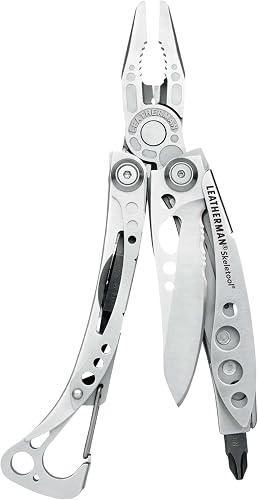

Leatherman Skeletool vs Skeletool CX: what changes?
The blade style is the main difference: the Skeletool has a combo knife, and the CX has a straight-edged blade. Their listed core functions overlap, so decide which blade better fits your regular cutting tasks.
Both models include pliers, wire cutters, a bit driver and a bottle opener. Each is described as a pocketknife with extra capabilities for everyday carry and outdoor use.
The Skeletool is listed at 5.6 oz and has a 4 in folded size. The CX is listed at 4.96 oz, with dimensions of 3.25 x 1 x 1 in.
Those measurements are presented differently, so don't assume they are directly comparable in every dimension. Check the carry space you have and the exact model dimensions before choosing.
Is the CX worth choosing for its blade?
Choose the CX if you want a straight-edged blade in the Skeletool format. Its product details also describe open-frame handles and a carabiner clip.
The CX is described as suited to outdoor minimalists, with examples such as opening a beverage or cutting paracord. That points to a compact tool for basic tasks, rather than a broad set of specialized implements.
If your use is mostly opening packages, trimming cord and handling small repairs, compare those tasks with the blade edge you prefer. A blade style you can use comfortably matters more than a small weight difference for many carry choices.
What does the standard Skeletool add?
The standard Skeletool gives you a combo knife and the same core tool mix. It is described for everyday jobs around home and garden as well as camping and hiking.
Its examples include tightening a loose screw, opening a beverage and cutting a bag of mulch. The carabiner clip and open-frame design are also part of its listed feature set.
The CX and standard models both have a bottle opener, pliers, wire cutters and a bit driver. If you use those functions more often than the blade, pick based on the blade and carry feel you want.
Which Skeletool is lighter to carry?
The CX has the lower listed weight at 4.96 oz, compared with 5.6 oz for the standard Skeletool. The difference is 0.64 oz, which may matter if you carry the tool every day.
Both models are described as slim and portable. Their product details frame them as everyday carry tools and options for camping or hiking.
A small weight difference won't decide fit by itself. Consider how the tool will sit in your pocket, clip to a bag or ride alongside other items.
For more compact carry ideas, see our guide to small multitools for a pocket or purse. If you want to compare where each belongs in a broader lineup, browse full-size multitools.
Which model suits everyday jobs?
Either model suits someone who wants a knife, pliers and a few common tools in one compact carry option. The CX leans toward straight-edge cutting and a lower listed weight; the standard model offers a combo knife.
For household tasks, both share a bit driver and wire cutters, along with pliers. Those functions can handle simple fixes and small jobs, while the bottle opener adds a familiar everyday use.
Neither is described as a large tool set with many specialized functions. If you regularly need more tool types, compare your needs with our everyday multitool guide.
Which blade fits your cutting tasks?
A straight edge is the CX's defining blade detail, while the standard Skeletool has a combo knife. Think about the materials and cuts you handle most often, then choose the edge that suits that work.
The Skeletool RX offers a different direction, with a 154CM serrated blade and a carbide glass-break bit. It is designed for emergency situations, so it makes more sense when those features serve a specific role or kit.
Avoid choosing the RX just because it has extra emergency features. For ordinary carry, the standard Skeletool and CX keep the comparison focused on the blade style and shared core functions.
Which one should you choose?
Choose the CX for a straight-edged blade and lower listed weight; choose the Skeletool for a combo knife. Both keep pliers, wire cutters, a bit driver and a bottle opener in a compact package.
The CX makes sense if the blade edge is your priority and you want the lighter of these two listed weights. The standard Skeletool is the straightforward pick if you prefer a combo blade and want a tool described for home, garden and outdoor tasks.
If you're weighing another Leatherman comparison, our Skeletool CX review looks at that model on its own. You can also compare the Rebar and Wave Plus if you want a different size and tool mix.
For the Skeletool family, choose by blade first, then confirm the dimensions suit your carry spot. That keeps the decision tied to the difference you'll notice most.
Sources
Frequently asked questions
What is the difference between the Leatherman Skeletool and CX?
The clearest difference is the blade: the standard Skeletool has a combo knife, while the CX has a straight-edged blade. The CX is also listed at 4.96 oz, compared with 5.6 oz for the standard model.
Both include pliers, wire cutters, a bit driver and a bottle opener.
Is the Skeletool CX smaller than the Skeletool?
The CX dimensions are listed as 3.25 x 1 x 1 in, while the standard Skeletool has a 4 in folded size. Those figures use different formats, so compare the exact dimensions that matter for your pocket or carry spot before choosing.
Which Skeletool is better for outdoor use?
Both are described for everyday carry and outdoor use. The CX is positioned for an outdoor minimalist and has a straight-edged blade, while the standard Skeletool is described for camping and hiking with a combo knife.
Choose by blade preference and the tasks you expect.
What is the Skeletool RX for?
The Skeletool RX is designed around emergency use, with a 154CM serrated blade and a carbide glass-break bit. It also has pliers, wire cutters, a bit driver and a carabiner-style bottle opener.
Pick it when those emergency features match your role or kit.


